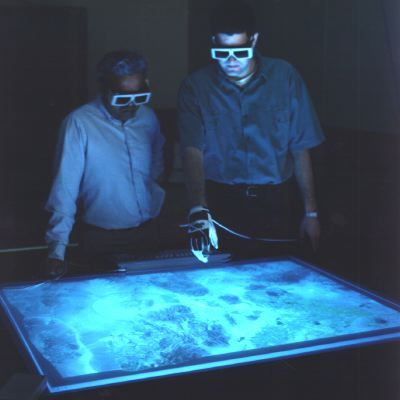
photo courtesy Naval Research Lab
Early observers would tell you that audiences watching film for the first time early in the 20th century sat in stunned silence. The images they were seeing were unlike anything from their previous reality. Adults seeing Virtual Reality (VR) for the first time early in the 21st century also sit and watch in amazed silence. It is because all VR technology - it is an optical illusion.
When viewing VR each of your two visual sensors (also known as eyes) are given conflicting visual cues. Your central processor, also known as your brain, is then forced to make some sense of this conflicting information. It does this by recombining the information to produce the only substitute it knows – three dimensions. Single image VR can be seen without the aid of a computer. But the computer provides the processing power to display movement and to allow a user to travel around inside a vast virtual reality space.
VR can be experienced in immersive or non-immersive modes. Immersive
is the mode that most people associate with VR. It requires an additional
aid such as a helmut, polarized glasses, or a moving screen. Non-immersive
mode, also known as 2 ½ D,
while not requiring special external equipment, does require a sophisticated
graphics processor to allow the visual images to be viewed at a comfortable
speed.
Immersive Technology
There are several types of immersive technologies. They include shuttered glasses, color filters, polarized filters, and lenticular displays. There are two types of non-immersive technology that provide true 3D imaging. They are parabolic mirroring and laser volumetric display.
Shuttered glasses
In this technique the user wears a pair of special glasses, such as
those seen below while looking at a computer screen.
photo courtesy Naval Research Lab
The left and right lenses in these glasses each have a shuttering mechanism, i.e. an electro-optical mechanism that opens and closes the lens. For a short time period only the left lens is open. When the left lens closes, the right lens opens. Then when the right lens closes, the left lens opens. This left eye, then right eye opening and closing process occurs as many as 120 times each second. Simultaneous with the shuttered glasses, the computer screen is being “repainted,” e.g. 120 times per second, with not one image, but with two images, called over/under, slightly offset from one another. The repainting is synchronized so that one image appears only to the left eye, and the other image only to the right eye. The brain is then left to meld the two images together – providing the 3D illusion.
Color Wavelength Filters

Each color we see has a different “wavelength”. The time it takes the
photons bouncing off a colored surface to travel through space differs
depending on the color. Just like light travels through air much faster
than sound, the various reflected photons travel through air at different
speeds. Light and other spectral phenomenon are measured in “Hertz” (Hz).
One Hz is one wave/vibration per second. The color red travels at about
4.3x10¹⁴ Hz while the color violet travels at about 7.5x10¹⁴. These differences
may be used to dramatize the visual effects of color. By wearing glasses
that contain materials that slow the photon transfer of certain wavelengths,
a visual effect of greater depth is provided.
Anaglyphs
An Anaglyph is the technical name for the technique that uses glasses with separate red and blue lenses to view pictures. The lenses filter out all colors but their own. Therefore the left eye, which has a red lens, only sees the red shades and the right eye, which has the blue lens, sees the blue shades. The brain is again tricked into combining them to give you the three dimensional images. The obvious disadvantage to this approach is that only limited monochromatic images can be seen.
Polarized Light and Filters
Since it is matter, light photons can be formed so that they are emitted from a source in different shapes. Imagine light that is flattened into a ribbon shape and then emitted. Imagine also a receptor that can only accept the flattened shape, like a flat thread going into a flat needle eye. This is the concept behind polarized light. Light is flattened into a north south polar basis by exposing it to magnetic charges. The images in that polarized light are then emitted outward. An observer who is wearing special polarized receptor glasses can then only see the light striking the glasses along that polar plane. Special polarized glasses are manufactured which contain a vertically (north-south) striated filter in the left eye lens and a horizontal (east-west) striated filter in the right lens. The computer screen is painted with two interleaved polarized images, one to be seen by the left eye, the other by the right. The advantage of this method is that it does allows full color pictures to be seen, but does require both special glasses and projection equipment. Frequently 3D film technology, such as the large screened IMAX, uses this method.
Lenticular Displays
Lenticular is a derivative of the word lens, which is a critical part of a lenticular display. This method operates by placing lenses between your eyes and the image being displayed. By placing one angle or thickness of lens on one eye and another angle or thickness on the other eye, and by synchronizing these lenses with multiple images being displayed simultaneously by the computer, a 3D effect is achieved. To the viewer without the lenses, the image appears overlapping and double, but to the lens wearer it provides an immersive effect – each eye seeing a different image.
Mirrored Displays
These types of displays use curved mirrors to fool the eye into seeing
an image that appears to float in space. Actually the viewer is seeing
a reflection of the original image on a parabolic mirror. Because the parabolic
mirror can be wrapped around the image, it can be viewed from all angles.
The significant advantage to this technology is that the viewer need wear
no device such as glasses. The limitation to this technology is that the
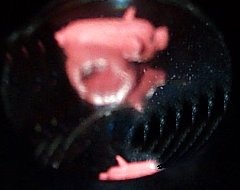
viewer can only see the display from a pre-set angle. A static mirrored
display is seen below. The pink pig predominant in the photo is actually
a reflected image. The actual pink object (small part visible) rests below
it at the bottom of the photo.
Volumetric Displays
These types of displays utilize either single or multiple screens, which are typically mirrored surfaces that rotate at a very fast speed, similar to the spinning of the children’s toy called a top. The screen motion is sufficiently fast that the eye no longer is able to see the surface itself. While the surfaces are spinning they are being “painted” or refreshed at a synchronized speed. The photon gun sending the picture beam must be instructed exactly when and where to place the photons in the 3D space. On a standard computer screen, the positions on the screen are known as pixels, which is short for picture element. On a volumetric display these positions known as voxels.
There is another type of volumetric display that works in a static space, i.e. without the spinning surfaces. It utilizes invisible laser beams, which, upon colliding, emit a single point of light. This type of static display requires that the display volume contain atoms, ions, or molecules that exhibit special quantum conversion efficiencies, output fluorescence frequency and decay times. The most promising medium at present employs rare-earth ions doped into an infrared-transparent glass.
These types of displays while providing amazing graphics remain very
expensive to build, and need highly customized software and data to operate.
© May 2000 John H. Saunders